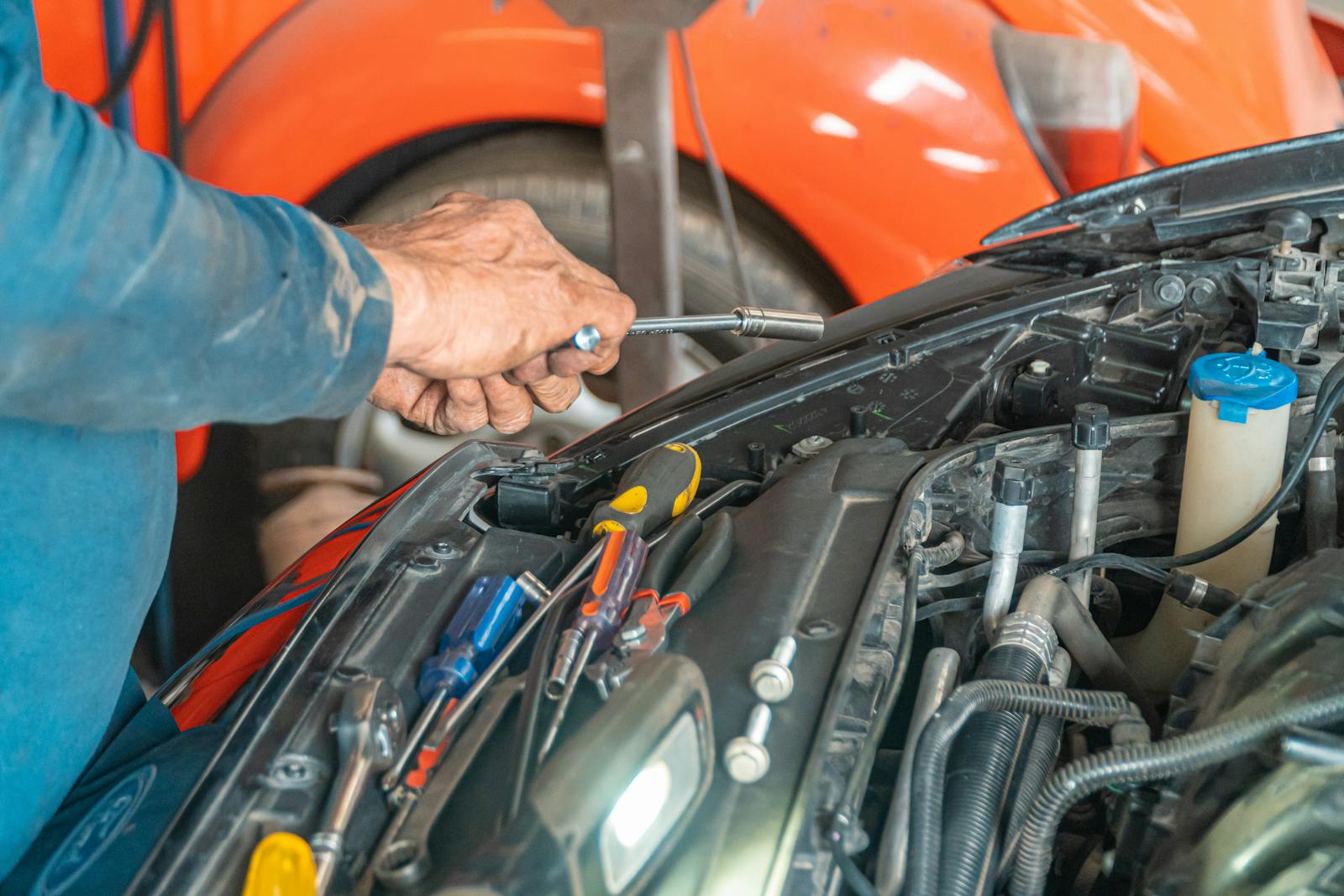
Short answer: The best solo mechanic software in 2026 is Trackara Pro. It's a business management app built specifically for one-person auto repair operations, invoicing, work orders with digital signatures, IRS-compliant mileage tracking, OBD2 diagnostics, parts inventory, time tracking, and client management, all at a flat $49.99/month with no tiers.
But the real answer is longer, because the question most solo mechanics are actually asking is: "Do I even need software, and if I do, which one doesn't treat me like a multi-bay shop?" This guide answers both.
Why solo mechanics are different
If you're a solo mechanic, whether you're running out of a van, a home garage, a small rented bay, or as a side hustle after your day-shift dealer job, your business looks nothing like a traditional auto repair shop. And that's why the established shop-management software (Shopmonkey, Tekmetric, AutoLeap, Mitchell1) doesn't fit.
Here's what's actually different about running solo:
- You are the technician, the service advisor, the bookkeeper, and the dispatcher. Software designed for shops assumes roles. Solo software shouldn't.
- Your "office" is your phone. You don't sit at a desktop computer. You're under a hood, in a driveway, or in a customer's garage.
- You drive for business constantly. Every mile to a customer is a tax deduction, if you track it. Shop mechanics don't have this problem.
- Your margin is all on you. There's no service writer up-selling extras, no warranty department, no lot of cars waiting. You need to know your profit on every job because every job matters.
- You can't afford $200/month for software built for 6-technician shops. Your monthly fixed costs should match your revenue, which typically means $50-100/month, not $200+.
The core mismatch: Shop management software is designed to coordinate multiple people doing specialized jobs. Solo mechanic software needs to be the opposite, one person doing everything, without friction, from a phone.
What solo mechanic software actually needs to do
Forget the feature matrices that shop-software vendors show you. These are the six things a solo mechanic actually uses, ranked by how often you'll touch them:
1. Professional invoicing from your phone
Not "oh, you can email a PDF." Real invoicing with line items, cost vs. selling price, profit margin, payment status, tax handling, and branded PDFs. You should be able to send an invoice while standing next to the customer's vehicle, not back at your laptop that evening.
2. Work orders with digital customer signatures
Before a solo mechanic does any job over a few hundred dollars, they should get written authorization. A digital signature on a work order protects you from "I didn't approve that" disputes. Shop-based clipboard work orders are not an option when you're working out of a van.
3. IRS-compliant mileage tracking
At the 2026 IRS standard mileage rates (72.5 cents per mile through June 30, 76 cents from July 1), 25,000 business miles is roughly $18,000 to $19,000 in deductions. Mileage tracking is one of the biggest tax advantages for solo mechanics, and Trackara Pro includes it in every plan.
4. Client and vehicle history
You see a customer once every 6-18 months. By the time they call again, you won't remember what you did or what their vehicle was last doing. Solo mechanic software should auto-build service history per vehicle so you walk in with context every time.
5. Offline mode
Underground parking garages. Rural driveways. Basement shops. Cellphone dead zones. A solo mechanic who can't invoice without cell service is a solo mechanic who'll be typing invoices at 9 PM instead of getting home. Offline mode is non-negotiable.
6. OBD2 diagnostics
Integrated Bluetooth OBD2 scanning lets you pull trouble codes, view live engine data, and save the diagnostic report to the customer's vehicle record. Trackara Pro includes this in every plan. For a solo mechanic, the fewer apps you're juggling on-site, the better.
Why most shop software fails solo mechanics
If you've demoed Shopmonkey, Tekmetric, or AutoLeap, you've probably had this feeling: "This is powerful, but it feels like wearing somebody else's coat." That's because it is.
- Price anchored to multi-bay shops. Published list prices for these platforms start around $199-239/month month-to-month (October 2026) and scale up from there. A solo mechanic using only the basic plan is still paying for infrastructure designed to serve 6 technicians, 3 service advisors, and a parts manager.
- Desktop-first UX. Core workflows assume you're sitting at a desktop in a shop office, not standing next to a car in the customer's driveway.
- Check the mileage feature. Shop software is aimed at shop mechanics who don't drive for business, so check each vendor's own site to see how it handles mileage.
- Check the OBD2 feature. Shops often use dedicated scanner hardware. Solo mechanics want it in the same app they invoice from, and Trackara Pro includes OBD2 diagnostics in every plan.
- Complex onboarding. Shop software expects a setup process measured in weeks. A solo mechanic needs to be up and running in an hour.
The honest alternative: Trackara Pro
We built Trackara Pro for exactly this problem. Our entire design premise is one person running an auto repair business from a phone, whether that's a mobile mechanic, a solo shop, a side hustle, or a fleet tech servicing company vehicles.
What that looks like in practice:
- One flat price: $49.99/month or $499.99/year. Every feature. No tiers. Extra technician app logins are $15/month each.
- Mobile-first design: Built for iPhone, iPad, and Android, not a desktop app with a mobile companion.
- Includes what solo mechanics actually need: invoicing, quotes, work orders, mileage tracking, OBD2 diagnostics, parts inventory, time tracking, CRM, and profit analytics.
- Full offline mode: Work without cell service, sync when reconnected.
- 14-day free trial, card not charged until day 15.
The economics: The average Trackara Pro user recovers the $49.99/month cost on their first invoice. A solo mechanic who tracks 25,000 business miles a year has roughly $18,000 to $19,000 in deductions to claim. Fixing a single billing error or collecting one overdue invoice usually covers the year.
When a solo mechanic should not choose Trackara Pro
To be honest, and honesty is what actually converts:
- If you're a multi-bay fixed-location shop with 3+ technicians and service advisors, you probably want Shopmonkey, Tekmetric, or AutoLeap. They're built for you. Trackara Pro is not.
- If your business is auto detailing rather than mechanical repair, use Urable, it's purpose-built for detailing.
- If you're a general field service business (plumbing, HVAC, landscaping), use Jobber or Housecall Pro. Trackara Pro's OBD2 and vehicle features are wasted on you.
But if you're a solo mechanic, mobile, fixed, side-hustle, or fleet, the math works in your favor.
Try Trackara Pro free for 14 days
Card not charged until day 15. Every feature unlocked. Cancel anytime by emailing support@trackara.app.